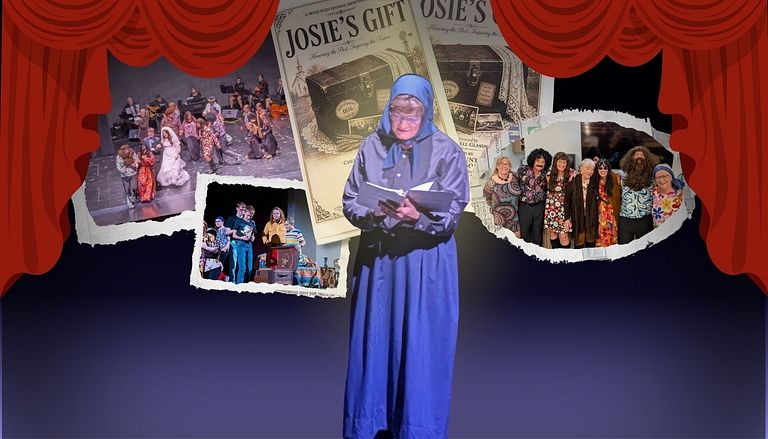
For Payroll Specialist Cheryl Stramel, stepping onto the stage for the production of Josie’s Gift was more than trying something new. It was a chance to step into a piece of her own family history.
The original production, presented Aug. 6 by the Ellis County Historical Society in cooperation with Hays Community Theatre, commemorated the 150th anniversary of the Volga Germans’ arrival in Ellis County. Through music, costumes, family stories and historical scenes, the play brought to life the experiences of the immigrants who came to western Kansas in 1876 and the generations that followed.
Cheryl was part of that story in more ways than one. “I had three parts in the play,” Cheryl said. “The narrator, an 1876 Volga German arriving in Kansas, and a 1970s wedding attendee.”
The opportunity came when playwright and director Cheryl Maxwell Glassman asked Stramel to audition. Although Cheryl had participated in smaller, 30-minute productions, usually involving singing, Josie’s Gift marked her first major production with Hays Community Theatre. Her connection to the theater came in part through her husband, Gene, who serves on the Hays Community Theatre board and regularly acts in productions. But there was another reason Cheryl was drawn to this particular play: her family.
Cheryl is a descendant of Volga Germans on her mother’s side, through the Geist family. That connection made participating in the production especially meaningful.
“Being a part of the Volga German did influence me to be part of this production,” she said. “It was very meaningful to experience the hard times they experienced.”
Those hardships were an important part of Josie’s Gift. The play explored the difficult journey Volga German immigrants faced, as well as the challenges of establishing new lives on the Kansas prairie. But it also celebrated the traditions, music, family and joy that endured across generations. And Cheryl got to experience one of the more joyful—and entertaining—parts of that history firsthand.
Her favorite part of the production was the 1970s wedding scene, where she traded historical hardship for polyester and a wig.
“I got to dress up in ’70s clothes and wore a wig,” Cheryl said. “It was one of the happiest moments in the play.”
While Cheryl may not be rushing to memorize lines for her next theatrical production, she said she appreciated the opportunity to be part of Josie’s Gift. As narrator, she could rely on her script, which was a welcome advantage for someone who admits memorizing lines isn't necessarily her calling.
“I am not sure if I would do a big production like this again,” she said. “As a narrator in Josie’s Gift, I was able to read from a script. I don’t think I can memorize lines for future plays.” Still, for one evening, Cheryl wasn't just telling the story of the Volga Germans. She was helping tell a story that was, in part, her own.
And perhaps that is what made Josie’s Gift such a fitting role. It brought together history, family, and a little bit of ’70s flair, all on one stage.


